|
|
 You can see more information by clicking on the tabs above
aka Curly Dock, Sour Dock
Rumex crispus
[1] Family: POLYGONACEAE
If we could only take a few herbs with us – this would be one of them

Yellow Dock - Rumex crispus - Healthy dock plants setting their flower stalks
|
Dock is such an all-round potent tonic and conditioner for the blood and circulatory system that it has beneficial effects - often profound - on nearly every ailment. It quickly brings the blood to an optimum state so that your body is much more proficient healing-wise and able to deal effectively with all manner of illnesses.
There are many varieties of Dock growing wild which are all edible. I use the leaves of these different varieties in salads, herbal teas and stir fries. Dock can be used fresh, dried or in tincture form. The root is used for medicinal purposes. Dock has powerful medicinal properties and acts as a natural iron in the human system.

Yellow Dock flowers closeup
|
Dock is a wonderful blood purifier and body cleanser. It is known to have helped heal scrofula, leprosy, cancer, tumors and swellings, it is especially helpful for ulcerated eyelids.
I have put some Dock leaves in a blender with water and applied it to itchy skin and it has provided instant relief.
Dock has also proven spectacularly successful in dealing with various forms of mouth infections in the gums and root canals.
As a practical means of preventing expensive dental work I have found Yellow Dock tea - 3 cups a day - very effective.
I usually brew a large pot in the morning and then drink it during the day, it works equally well taken hot, warm, cool or cold.
Yellow Dock is and was a favorite herb in many ancient cultures, with old time doctors, settlers and herbal practitioners. For some conditions we have found there is no equal. It is rich in easily-digested plant iron an essential mineral for man, animal and plant life.
This common herb has invaluable ingredients for conditions of the blood and glandular system and is indicated in scrofula, eruptive diseases, especially when discharges are experienced, as in running of the ears, ulcerated eyelids and skin conditions - such as rashes, eczema, itches, scurvy etc.
Yellow Dock leaves contain ascorbic acid (aka Vitamin C), quercetin and zinc which make this plant one of the most effective natural protections from both the SARS-CoV-2 virus and also the spike proteins which Pfizer has confirmed “vaccinated” people can “shed” [2][3] and which may cause harm to the “unvaccinated”. That is why it is a major component of our ContamiShield remedy.
 Whips the blood into shape restoring its ability to distribute nutrients and eliminate toxins from the system. Can ease abscess-induced toothache in minutes - a must in the medicine chest and marvellous on the meal table
When internal toxic buildup reaches the stage of cysts or tumours, Yellow Dock is of profound effectiveness both internally & externally. Many Herbalists use the mineral-rich plant for cancer, leprosy, bleeding of the lungs & bowels and for rheumatic conditions.
It also has much efficacy in dyspepsia, chronic bronchitis, ulcers and conditions affected by the spleen and lymphatic glands; also for female weakness when due to iron deficiency or loss of blood.

Yellow Dock hanging in the drying kiln
ready to start its journey towards a
refreshing and healthy herbal tea!
|
We dry quantities of Yellow Dock for making teas by infusion and we make tinctures from the fresh leaves, stems and roots.
Most of these plants have been used throughout mankind's history on planet earth for their medicinal and therapeutic properties.
Here you can see a quantity (about 12 KG) of dock leaves ready to start its processing journey.
You can see what's involved in processing a plant to make a herbal tea here.
I have found that these conditions are helped immensely by Yellow Dock
[4] :
|
|
- Liver Problems
- Skin Problems
|
Yellow Dock is recommended for these other conditions as well:
- Abcesses
- Acne
- Bladder
- Boils
- Childhood Diseases
- Cleansing
- Diabetes
- Digestive Disorders
- Earache
- Ear Infection
|
- Eye Infections
- Fatigue
- Fever
- Flu
- Fractures
- Gall Bladder
- Glands, Swollen
- Gout
- Inflamation
- Itching
|
- Pancreas
- Pituatory Gland
- Psoriasis
- Spleen
- Tumors
- Ulcers
- Venereal Disease
| Why wait for Wholesome Good Health |
|
tea
|
tincture
|
|
Contra-indications: May cause dermatitis. Excessive doses produce nausea.
Uses from Asia include
[5]
- Yellow dock is used in traditional medicine as a gentle laxative or mild astringent tonic.
- It encourages both bowel movement and good digestion by stimulating the release of gastric juices.
- An ointment of yellow dock is valuable for eruptive skin conditions that cause itching, sores, and scabby skin lesions.
- The American Indians used yellow dock leaves to treat boils, and the pulverized roots to treat cuts.
- The root has laxative, alterative and mildly tonic action, and can be freely used as a tonic and laxative in rheumatism, bilious complaints and as an astringent in piles, bleedings of the lungs, etc.
- It is useful for relieving a congested liver, as well as for scrofulous skin diseases.
- The seeds are used in dysentery, for their astringent action.
- A decoction prepared from yellow dock is an immensely beneficial laxative and helps heal constipation.
- Yellow dock is also beneficial for curing bowel infections as well as treating peptic ulcers.
- It also removes toxins from the body through the urinary system. Yellow dock roots are also beneficial for healing gout, arthritis, cystitis, water retention, urinary stones and gravel.
- The herb is also beneficial for women as it has been extensively used for healing unbalanced menstrual cycles, heavy bleeding during periods, menstrual pain and also as fibroids in the uterus.
- The yellow dock roots are rich in iron content and hence offer an exceptional medication for anemia.

Major medicinal actions of Yellow Dock [6]

Yellow Dock Tincture
|
- analgesic
- anthelmintic
- antiaging
- antibacterial
- antibiotic
- anticancer
- antidepressant
- antidiabetic
- antihypertensive
- antiinflammatory
- antileukemic
- antimalarial
- antioxidant
- antipyretic
- antirheumatic
|
- antiseptic
- antispasmodic
- antitumor
- antitussive
- antiulcerogenic
- antiviral
- ascorbic-acid
- astringent
- beta-carotene
- cardiotonic
- cathartic
- choleretic
- detoxicant
- diuretic
- dye
|
- fungicidal
- hemostatic
- hypotensive
- laxative
- niacin
- purgative
- riboflavin
- rubefacient
- sedative
- styptic
- thiamin
- vulnerary
|
That is a lot of health-maintaining activity in just one plant. However there is more - here are other actions attributed to the constituents found in Yellow Dock. Of course not all of these are considered major actions of Yellow Dock, however the list does demonstrate just how comprehensive Yellow Dock’s health maintaining abilities are.
Other actions of Yellow Dock [6]
.

Major constituents of Yellow Dock [6]
Yellow Dock Tincture
|
Vitamins
Yellow Dock contains vitamins A, B and C.
Minerals
Yellow Dock contains these minerals: Iron, Sodium, Potassium, Magnesium, Calcium and Zinc.
[6]
Active constituents found in Yellow Dock
- aluminum ( Root 390 ppm )
- anthraquinone compounds
- ascorbic-acid ( Leaf 300 - 4,054 ppm )
- avicularin
- beta-carotene ( Leaf 10.38 - 140 ppm )
- calcium ( Leaf 740 - 10,000 ppm )
- chromium
- chrysophanic acid
|
- citric acid
- cobalt ( Root 35 ppm )
- emodin
- erucic acid
- fiber ( Leaf 9,000 - 121,612 ppm )
- galactose
- gallic acid
- glucose
- hyperoside
- iron ( Root 760 ppm )
- magnesium ( Root 3,200 ppm )
- malic acid
- manganese ( Root 145 ppm )
- nepodin
- niacin ( Leaf 4 - 54 ppm )
- oxalic-acid
- phosphorus ( Leaf 560 - 7,568 ppm )
|
- physcion
- potassium ( Root 12,200 ppm )
- quercetin
- quercitrin
- riboflavin ( Leaf 0.8 - 10.8 ppm )
- rumicin
- rutin
- saponins
- selenium
- silicon ( Root 13 ppm )
- sodium ( Root 77 ppm )
- tannin ( Root 30,000 - 60,000 ppm )
- tartaric acid
- thiamin ( Leaf 0.6 - 8.1 ppm )
- tin ( Root 24 ppm )
- zinc
|

Yellow Dock tea
|
Why choose a Herbal Tea?
Plants produce a vast range of substances -
phyto-chemical s - which are very beneficial in restoring and maintaining health in we humans without side-effects. We believe that they are perfectly suited to preventative and curative health care because they are natural and harmonious to our bodies.
If you do not have fresh Yellow Dock nearby or are not confident you can identify Yellow Dock then dried material is the next best way to obtain their beneficial influence.
How long will Yellow Dock tea keep it's potency?
Stored properly - in an air-tight glass container away from direct sunlight - Yellow Dock tea will keep for up to 18 months without losing it's potency. If you are dealing with the onset of a severe condition we suggest it may be worth purchasing fresh material to have complete confidence in its healing potency.
When should I drink my Tea?
For best absorption, consume herbal teas 30 minutes or more before meals or drinking other liquids to avoid diluting it while it is in your digestive tract.
Caring for your Yellow Dock herbal tea
If you don't plan on using the tea immediately, it's best to keep it unopened and away from direct sunlight (in a closed cupboard or drawer). Exposed to the air it may absorb moisture and humidity, so if they are opened, reseal them tightly, or (preferably) put it in a glass jars with a tight-fitting lid (avoid metal containers).
Most will never require refrigeration or freezing - just keep them at average room temperature (70-80 degrees). Generally, the "shelf-life" for optimum freshness will be about a year if stored properly.
If you live in a warm, high humidity area, it may be impossible to keep moisture out of regularly opened and closed glass containers, and the plants may become mouldy. If this happens, discard them and purchase fresh ones. To prevent mould, try storing them in paper lunch bags so they can “breathe” (although this will reduce the shelf-life significantly).
Making an Infusion

pour a cup after it has infused
|
Preparing an infusion is just like making a cup of tea but allowing more time for the water to absorb the Yellow Dock essence.
Pour boiling water over the tea (use a glass, stainless steel or ceramic vessel), cover it and allow to soak/steep for 20 minutes or so. Stirring it a few times while steeping is helpful - and is an ideal opportunity to focus your mind on the benefits it will bring to you.
Generally use 1 teaspoon of dried Yellow Dock in a 250ml cup of water is sufficient. The standard dosage is one teacup (250ml), two or three times daily.
For convenience, your entire day's dosage can be prepared at night (2-3 cups at one time) and left overnight and then refrigerated for use throughout the day. You can drink it cold or heat it if you want it warm.
Making a Decoction
Because some tea (with bark, stems or roots in them) contains tough, woody material, a decoction is the recommended method for making your medicine.
Instead of just soaking it in hot water, the plant material is boiled for a longer period of time to soften the thicker woody pieces and release its active constituents.
Use a ceramic, glass or enamel pot with a snug fitting lid, if you don't have one then a stainless steel pot is good but definitely not aluminium or teflon.
Add the amount of herb needed (1 teaspoon per 250ml of water) to the proper amount of cold water in the pot depending on how many doses you wish to prepare.
Turn the heat to medium high and bring to a vigorous boil then put the lid on the pot and reduce the heat to maintain a gentle but cheerful simmer for 20 minutes.
If you can see steam escaping or smell the aroma of the herb, your lid is not tight enough and valuable essential oils may be escaping.
After 20 minutes, remove from heat and cool slightly, for maximum potency we encourage you to let it stand overnight.
Strain the mixture through a tea strainer into a wide-necked bottle, jug or cup, making sure to press on the material in the strainer with a spoon or similar to get as much of the liquid/decoction out of the material as possible.
Standard dosages for decoction are generally one-half to one cup, two or three times daily.
A day's dosage can be prepared the prior evening (2-3 cups at one time), allowed to continue to soak while it cools overnight to ensure maximum potency and refrigerated until ready to use throughout the next day.
Is it Safe for me to take Yellow Dock Tincture? If you have any concerns or apprehensions please use our free Herbal Tincture enquiry service so that we can make sure that what you want is completely safe for your situation or condition.
We especially encourage you to get in touch if you have any of the following health problems or conditions:
- An enlarged prostate gland
- Are preganant or breast-feeding
- Blood clotting problems
- Cancer
- Diabetes
|
|
- Epilepsy
- Glaucoma
- Heart disease
- High blood pressure
- Immune system problems
|
|
- Liver problems
- Psychiatric problems
- Parkinson's disease
- Stroke
- Thyroid problems
|
You have two options when you purchase Yellow Dock tincture:
- For external use which you can apply externally to the soles of your feet or topically on an external condition - you can purchase these without a consultation.
- For internal use. If you wish to take it internally because of the potency of these tinctures you need to be sure they will not cause complications with an existing health condition or prescribed drugs you may be taking.

Yellow Dock tincture
|
If you are in any doubt about the possibility Yellow Dock tincture causing complications with prescription drugs or a medical condition you may have please get in touch so that we can advise you on the suitability of a particular tincture.
Especially if you are pregnant or breast-feeding.
You can have an online consultation or visit our clinic for a thorough consultation if you wish to purchase our potent tinctures for internal use.
There are fewer concerns when using Yellow Dock tincture externally and our many years of experience has shown that the tincture is just as effective being applied into the soles of the feet or applied
topically
on external conditions where they will be absorbed into your system.
Our clients who have come for a consultation use the same tincture internally and we recommend they take half an eyedropper (about 1.5ml) of herbal tincture in a small glass of water three times per day for adults and a quarter of an eyedropper in a small glass of water for children.
Yellow Dock tincture is a potent liquid extract made from organic Yellow Dock. It is a concentrated way of getting herbal medicine into your body easily especially applying them to the soles of your feet. Once a tincture is prepared, it has an extremely long shelf life. Tinctures should be kept in a cool, dark cupboard to maintain their potency.
If you are on any prescribed medication we strongly advise you to use our free Herbal Tincture enquiry service to make sure that the medication and potent Yellow Dock tincture are compatible.

making medicine for internal use
|
How to Use Yellow Dock Tincture internally
How do I prepare my Yellow Dock Tincture?
Just add the recommended dosage - which is usually 1.5ml or one eyedropperfull - to a glass of drinking water or any other cold drink.
Then drink it.
When should I drink my Yellow Dock Tincture?
For best absorption, consume herbal tinctures 30 minutes or more before meals or drinking other liquids to avoid diluting it while it is in your digestive tract.

How to Use our Tinctures externally

how to apply a tincture to the soles of your feet
|
If you are treating an external condition - such as a skin infection - then simply apply the tincture directly to the site using the eyedropper or a suitable swab.
If you are treating an internal condition then the best way to get the tincture into your body is through the soles of your feet. The skin is a highly absorptive organ and the feet have the reflexology facility which helps get the healing properties of the herbs right to the place inside you where they will do the most good.
If you don't have someone to do it for you, the easiest way we've found is to apply it sitting down. Rest one foot on your other leg's thigh (use a towel to make sure the tincture doesn't drip on your furniture or clothes), squirt a small amount of tincture onto the palm of one hand (about 1.5ml or half an eyedropper), rub it gently into the sole of your foot. In most cases you will find it has been absorbed within 30 seconds or so - you'll know when your foot feels dry. Then do the same to your other foot and the treatment is complete.
Yellow Dock history

Yellow Dock by the roadside
|
Yellow Dock Root has been known for centuries as an outstanding blood purifier
[7] [5] [8] [9] . In ancient times, Yellow Dock Root was used in traditional herbal medications as a health tonic to relive stress and invigorate the body. It was also used as a poultice for common skin disorders and for wounds. It significantly reduced skin inflammation and skin irritation
[10] .
Yellow dock has touched many Native American tribes
[11] . All parts of the plant were used internally and externally as medicines.
- The Dakota used the bruised green leaves to draw out pus from wounds.
- The Blackfoot, Cheyenne and Dakota tribes used the mashed fresh root pulp for rheumatic pains, swelling and sores externally.
- The Iroquois also applied this mash to piles, and as a poultice in yellow fever.
- The Cherokee, as well as the tribes mentioned above, used the root internally for constipation, and to inspire the body to cleanse the blood. Their specific indications for use were jaundice, chronic skin afflictions, intestinal colds and pain, and kidney trouble. While the root was an emetic, many of these same tribes drank a hot infusion of the seeds for diarrhea.
- The Navajo considered yellow dock to be life medicine, and deemed it a panacea, or a cure for what ails you. Yellow dock’s healing power is characteristic of the direction of the east, a direction that supports life, light and growth. The Navajo used the whole plant as an emetic before ceremony to clear and cleanse the system in order to prepare the body for healing and spiritual ritual.
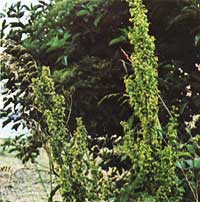
Rumex crispus L POLYGONACEAE
Yellow Dock Curled Dock/Rumex
In ancient writings both this species and another common weed, the Broad-leaved Dock (R. obtusifolius L) have been used for the same medicinal purposes, and more recently they have been shown to possess similar chemi- cal constituents. R. obtusifolius was known as Lapathum or Lapathum acutum from the fourteenth century, while the Yellow Dock was called Lapathum crispum. In the development of physiomedicalism in the early nineteenth century in America, R. crispus was used for obstinate skin complaints, while in Europe R. obtusifoliw was used for the same condition. today Rumex is found in English herbals, and Lapathum in European ones.
Description Perennial 50- 100 cm tall on stout rootstock. Leaves with undulate edges, lanceolate, large, crispy. Flowers greenish, small, in whorls along a somewhat branched inflorescence, appearing mid-summer to mid-autumn.
Distribution Eurasian native, widely distributed in temperate and subtropical countries as a weed. In any rich, heavy soil in weedy places, to 1500 m altitude.
Cultivation Wild. Propagate from seed.
Constituents (root-stock) Oxymethylanthra- quinone (to 0.2%); emodin (to 0.1i%); chrysophanic acid; volatile oil; resin; tannins; rumicin; starch; thiamine. The combined action is both astringent and purgative, and is described as tonic laxative.
Uses (root-stock, young leaves, rarely seed) Purgative; cholagogue; tonic; astringent. Of much value both internally and externally in skin complaints, especially where the cause is associated with constipation or liver dys- function. May be applied to ringworm, scabies and urticaria, the parasites probably being destroyed by the rumicin content.
In small doses it is stomachic and tonic, and in China it is considered antipyretic. The powdered root-stock in water is employed as a gargle for laryngitis and as a tooth powder in gingivitis. The seed is highly astringent and may be used in cases of diarrhoea.
Young leaves may be eaten as greens, but water should be changed twice during cooking.
Contra-indications May cause dermatitis. Excessive doses produce nausea. |
Yellow Dock cultivation
Yet another potent medicine regarded by the agricultural authorities as a “weed”
[12] [13] [14] [15] .
Yellow Dock prefers moist soil and we have found it growing in the roadside drainage ditches between Brisbane and Melbourne - almost continuously. It especially flourishes wherever the runoff from a dairy gathers in any depression.
It does well in full sun and partial shade and will grow in almost any soil conditions - including roadbase.

Yellow Dock flowering by the roadside
|
Yellow Dock video footage
|
|
Some video showing you Yellow Dock courtesy Dancing Spectrum Video
| Some video showing you Yellow Dock |
You can see more information by clicking on the tabs below
middlepath.com.au> Middle Path> Plants> Yellow Dock Rumex CrispusReferences
|
|


